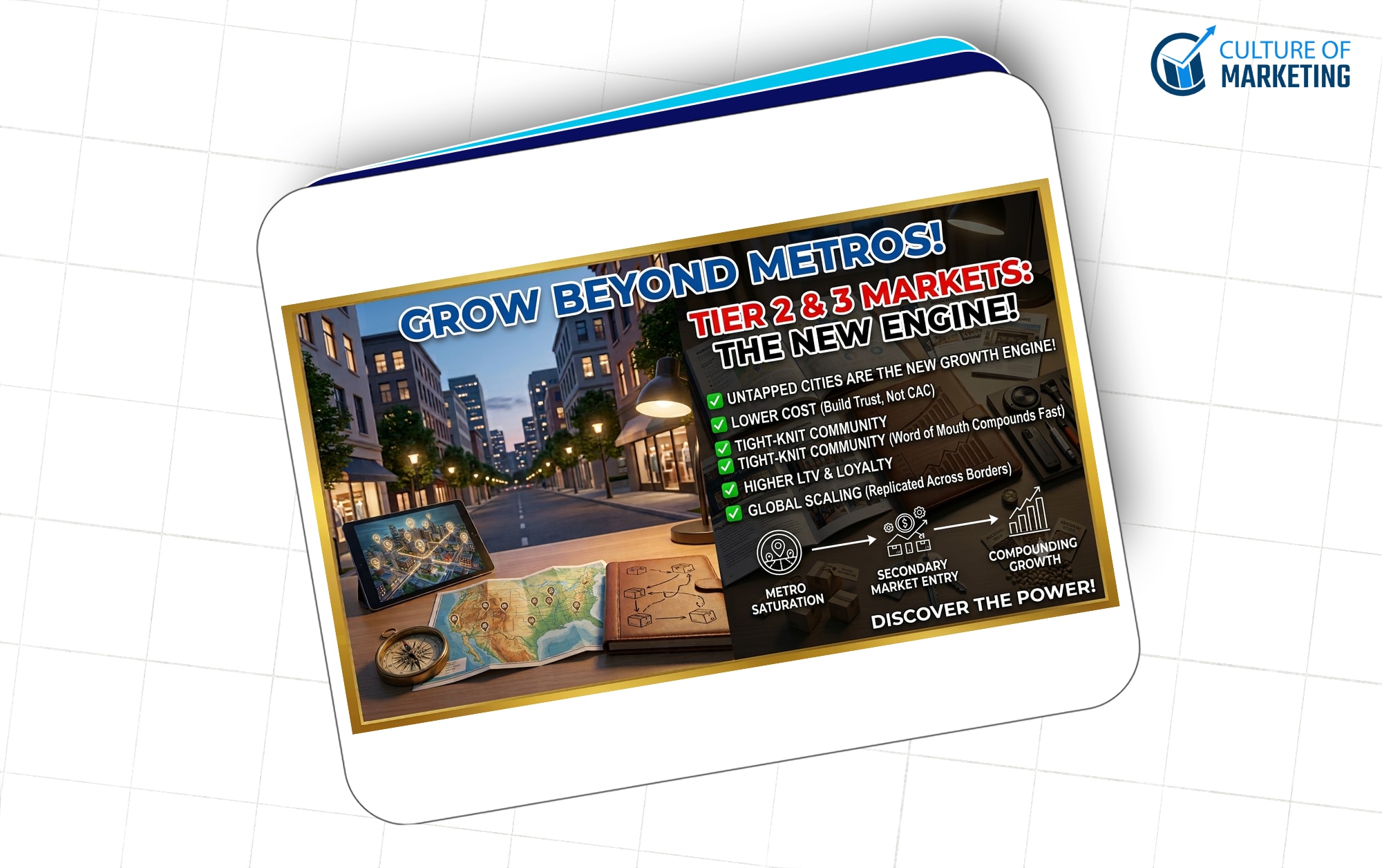
Why Tier 2 & Tier 3 Markets Are the Real Growth Engine
Every brand wants to be in New York. Every global retailer plants their flag in London first. Every tech company measures itself by how it performs in Los Angeles, Chicago, Sydney, Toronto. The big cities feel like the real test — if you can make it there, the thinking goes, you have proven something worth proving.
And for a long time, that logic held. The major metros had the money, the media, the cultural influence, and the consumer base that moved markets. You built your brand in a tier 1 city and let the reputation trickle down from there. It was slow, it was expensive, but it worked.
That model is breaking. Not dramatically, not all at once — but steadily and unmistakably. The brands that are seeing genuine, compounding growth right now are not the ones doubling down on already-saturated metros. They are the ones that quietly turned their attention to the cities that nobody in the boardroom was talking about. The second cities. The regional hubs. The mid-size markets that sit outside the spotlight but inside a massive, underserved consumer opportunity.
Tier 2 and tier 3 markets are not the consolation prize for brands that could not crack the big leagues. They are where the next decade of real growth is actually going to come from. And the brands that understand this early are going to look very smart very soon.
The Metro Trap Is Real and Most Brands Are Stuck In It
Here is the honest problem with chasing tier 1 cities: everyone else is doing it too.
Walk through the marketing strategy of almost any mid-to-large consumer brand and you will find the same playbook. Concentrate spend in major metros. Build brand awareness where media is concentrated. Win the urban professional. Everything else comes later, once the flagship market is established.
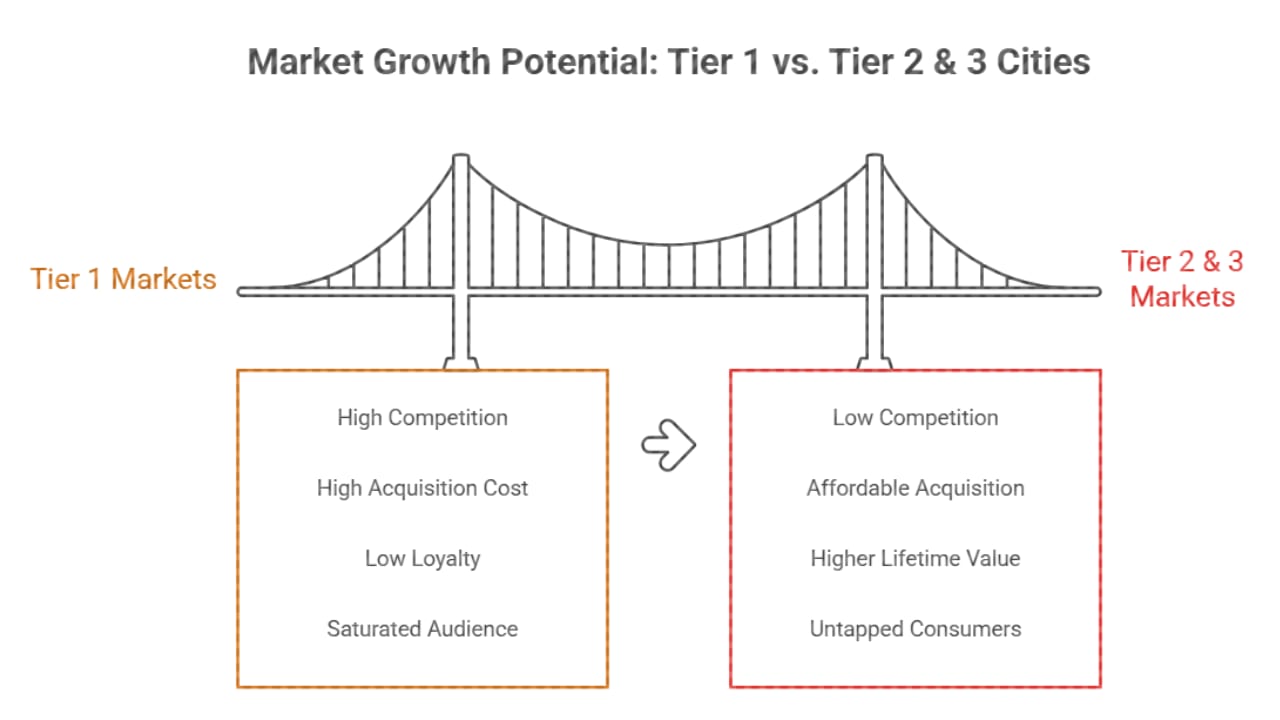
The result of everyone following this playbook simultaneously is a metro market that is exhausted. Customer acquisition costs in major cities have climbed year after year as competition for the same eyeballs intensifies. The urban consumer has seen every brand, heard every pitch, and developed a sophisticated skepticism toward all of it. They switch constantly. They respond to discounts and forget the brand the moment the discount ends. Loyalty in a saturated metro is genuinely difficult to build because the next alternative is always one ad away.
Meanwhile, in markets one or two tiers below — the regional cities, the secondary hubs, the fast-growing towns that do not make the marketing conference agenda — the competitive landscape looks completely different. Fewer established players. Less noise. Consumers who are actively looking for quality options and not finding enough of them. The economics of customer acquisition are lower, the lifetime value of a loyal customer is higher, and the word-of-mouth networks are tighter and more effective.
The brands stuck in the metro trap are paying more to get less. The ones who figured out tier 2 and tier 3 markets are paying less to get more. That gap is only going to widen.
These Consumers Are Not Who You Think They Are
The biggest misconception about tier 2 and tier 3 markets — and this applies whether you are talking about secondary cities in the US, emerging economies in Southeast Asia, or regional hubs across Latin America and Africa — is that the consumer there is somehow less sophisticated, less aspirational, or less valuable than their metro counterpart.
That assumption is wrong, and it is costing brands real money.
The tier 2 consumer in almost every major economy has been quietly upgrading their expectations for years. They watch the same content as metro consumers. They see the same trends, the same products, the same brand stories. The information gap that once existed between a consumer in a major city and one in a regional city has essentially collapsed, driven by smartphones, social media, and the kind of global content access that did not exist fifteen years ago.
What has not collapsed is the supply gap. The tier 2 consumer knows what they want — they have seen it, they have researched it, they have been building up to the purchase — but the brand has not shown up in their market yet. Or it has shown up half-heartedly, with a watered-down version of the metro experience, communicating like the smaller city customer is an afterthought rather than a primary audience.
That gap between what a tier 2 or tier 3 consumer wants and what is currently available to them is where the opportunity lives. It is not a small gap. In most markets, it is enormous. And filling it — thoughtfully, seriously, with the same quality and commitment you would bring to a flagship metro launch — is how real market positions get built.
First Mover Advantage Means Something Different Outside the Metros
In a tier 1 city, first-mover advantage is almost a myth. The market moves so fast, competition enters so quickly, and consumers switch so readily that being first rarely translates into lasting position. You might get a window of six months where you own a category before three competitors show up with better funding and undercut you.
In a tier 2 or tier 3 market, first-mover advantage is real, and it compounds.
When a brand enters a secondary market and delivers a genuinely good experience — when it shows up consistently, communicates in a way that respects the local consumer, and builds a reputation through real product performance rather than advertising volume — it earns a position that is very hard to dislodge. The consumer who discovered your brand first, who had a positive first experience, who told their friends and colleagues about it — that consumer becomes a root system for your brand in that market.
The competitive dynamics in smaller markets also work in your favor. A challenger brand trying to displace you has to work against the relationships you have already built with local retailers, local media, and local community figures. In a metro, those relationships are replaceable because there are hundreds of alternatives. In a mid-size market, they are not. Local presence, local trust, and local reputation are genuine moats, and they cost a fraction of what it would take to build equivalent brand equity in a major city.
This is why the brands that went into secondary markets early — that treated them as primary opportunities rather than eventual rollout phases — are sitting on assets today that their late-moving competitors would struggle to replicate even with significantly larger budgets.
The Word of Mouth Economy Is Stronger Here
There is something about mid-size markets that every brand discovers once they actually start paying attention to them: the social fabric is tighter.
In a major metro, a recommendation from a satisfied customer travels a certain distance. It reaches some people in their network, gets lost in the general noise of a city where everyone is seeing hundreds of brand messages a day, and produces a modest lift. Word of mouth works in big cities, but it works slowly and diffusely.
In a tier 2 or tier 3 market, a recommendation travels differently. The networks are more interconnected. People know each other across fewer degrees of separation. A genuinely good experience with a brand gets talked about in ways that move through a community with real velocity. The local businessperson who becomes a brand advocate, the community figure who mentions your product, the neighborhood conversation that turns into a referral chain — these things produce results in smaller markets that would take ten times the effort to achieve in a metro.
This is also why a negative experience travels faster in these markets. The accountability cuts both ways. Brands that show up in tier 2 and tier 3 markets with a halfhearted version of their metro offering — lower quality, less attention, the sense that the smaller city customer is getting second-best — find out quickly that the community talks. The standard that earns loyalty in these markets is not lower than in metros. In some ways, because the trust is more personal and the alternatives are fewer, it is higher.
The Global Version of This Story
It is worth stepping back and saying clearly: this is not a story about one country or one region. The tier 2 and tier 3 market opportunity is a global phenomenon, and it is playing out simultaneously across almost every major emerging economy.
In Southeast Asia, the growth story has moved decisively beyond the capital cities. Jakarta and Bangkok got the first wave of e-commerce and consumer brand investment, and now the growth is in Surabaya, in Chiang Mai, in the secondary cities where middle-class consumption is accelerating and brand supply has not caught up. In Latin America, the same pattern is visible beyond São Paulo and Mexico City. In Africa, it is playing out beyond Lagos and Nairobi. In Eastern Europe, beyond Warsaw and Bucharest.
Even in mature Western markets, the story has relevance. The American brand that focuses entirely on New York, LA, and Chicago is missing a consumer in Nashville, in Columbus, in Raleigh, in Salt Lake City — cities that have been growing economically and demographically while the coastal metros have stagnated or seen population decline. The European brand fixated on London and Paris is missing Rotterdam, Lyon, Leipzig, and a dozen other cities where educated, affluent consumers are underserved by serious brand attention.
The geography of growth has shifted. The brands and marketers who update their mental maps to reflect that shift are going to find opportunities that feel almost unfairly advantaged compared to the brutal competition still happening in the old centers.
What Actually Getting This Right Looks Like
Talking about the tier 2 and tier 3 opportunities is easy. Actually capturing it requires a few things that most brands find uncomfortable.
It requires patience. These markets do not respond to a single campaign or a one-quarter push. The consumer takes longer to warm up, not because they are less capable of making decisions, but because they have less prior experience with your category, and they need more time to build the kind of trust that converts to a purchase. The brands that go in expecting metro-speed results and pull out when they do not materialize are the ones that lose the opportunity. The ones that commit to a multi-year presence are the ones that own the market five years later.
It requires genuine localization. Not just translating a metro campaign into a regional accent, but actually understanding what matters to the consumer in that specific market — what their lives look like, what problems they are trying to solve, what cultural context shapes how they receive a brand message. This is not complicated to do, but it requires actually caring enough to find out.
It requires distribution that reaches the consumer where they are, not where is convenient for the brand. The tier 2 consumer is often not fully served by the same digital-first, ship-from-center models that work in metros. Physical presence, local retail partnerships, regional logistics — these matter more in these markets, and the brands willing to build them have a structural advantage over the ones that are not.
The Engine Has Already Started
The tier 2 and tier 3 growth engine is not a future story. It is a present one. The consumption is happening now. The aspirations are already formed. Consumers are already making decisions — they are just making them with whichever brands are willing to show up.
Every month that a brand delays taking these markets seriously is a month that a competitor — possibly a smaller, more nimble one with lower overhead and higher local knowledge — is spending building the relationships and the reputation that will be very difficult to displace later.
The big city bias in marketing is deeply embedded, and it will not disappear quickly. But the data is increasingly difficult to argue with. The growth is outside the metros. The loyalty is easier to build there. The economics are better. The competition is thinner. The consumer is ready.
The only real question left is which brands are willing to actually go there.