AI Content Flood Is Killing Brand Trust
I want to share with you something that most marketing blogs won't openly discuss.
A lot of what you're reading online right now — including content from brands you probably follow and respect — was written by a machine. And your customers? They're starting to figure that out. Not always consciously. But somewhere in the back of their mind, something feels off. The blog post sounds a little too clean. The email copy feels a little too generic. The social caption could've been for any brand in any industry.
That feeling has a cost. And brands are starting to pay for it.
Here's What's Actually Happening Right Now
The marketing world went all-in on AI content fast. Like, really fast. Today, 92% of large marketing teams are using AI-generated content in some form. That's not a trend anymore — that's the standard. And from a pure efficiency standpoint, it makes complete sense. More content, faster, cheaper. The pitch basically sells itself.
But here's where the story gets uncomfortable.
Only 38% of consumers feel positively about AI, while 77% of marketers and advertisers do. Read that again. The people making the content love the tool. Are the people supposed to connect with that content? More than half of them already don't trust it. That's not a minor gap in perception — that's a wall.
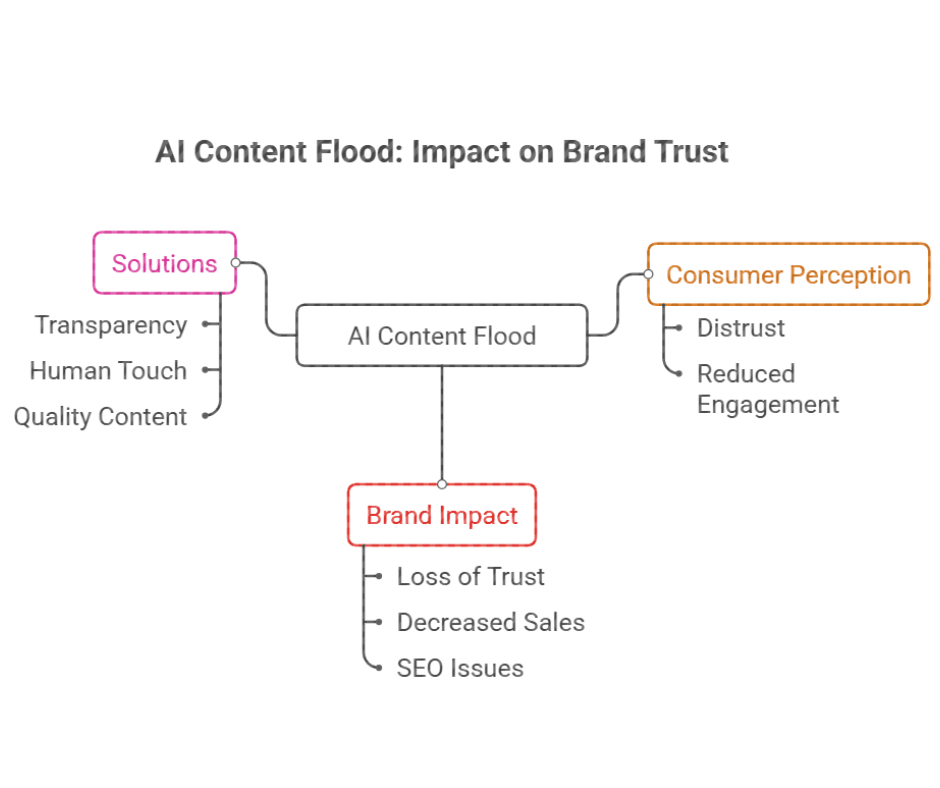
And it's not just a vague feeling of unease. About 52% of consumers say they actively engage less with content once they believe it was AI-generated. Less clicking. Less reading. Less buying. That's happening inside your conversion funnel, whether your analytics dashboard is showing it yet or not.
The Internet Is Starting to Feel Like a Content Junkyard
Here's the thing nobody wants to say: when everyone uses the same tools to create content at scale, everything starts to sound the same.
Think about how many blog posts you've skimmed in the past month that all had the same structure, the same subheadings, the same five-step framework at the bottom. The AI didn't just generate words — it generated a pattern. And that pattern is now everywhere. Over 15 billion AI-generated images were on the internet by the end of 2023, and the text output numbers are just as staggering.
What happens when your brand is one voice in a sea of identically-patterned content? You disappear. Not because your product is bad. Not because your strategy is wrong. But because you sound like every other brand that handed their content calendar to an algorithm.
The brands that are standing out right now are the ones that sound like actual people made deliberate choices about what to say and how to say it. That's not a small thing. That's the whole thing.
Your Audience Is Getting Smarter About This — Faster Than You Think
A year ago, most consumers couldn't reliably spot AI content. Today, half of them can.
And the moment they spot it, they're out. Less time on your page. Less trust in your brand. Less willingness to share or recommend you to someone else. The Reuters Institute found that 58% of people are actively worried about the authenticity of content they encounter online — and that worry doesn't stay in the news category. It follows people into every brand interaction they have.
They're reading your emails differently now. They're scrolling your website with a new kind of skepticism. The question running quietly in the background is: did a real person think this through, or did someone hit a button?
If your content makes them feel like it was the button, you've already lost the moment.
Being Honest About It Actually Works (But Only If You Mean It)
Here's something interesting. When brands clearly disclose that content is AI-assisted, trust scores go up — significantly. We're talking about a 73% increase in ad trustworthiness and a 96% lift in overall brand trust when disclosure notices are included. That's nothing.
But read that carefully. The lift comes from transparency, not from AI itself. What consumers are rewarding is honesty. The fact that a brand said, "here's how we made this and here's where a human was involved." That's what moves the needle.
86% of consumers believe AI-generated content should be labeled. And 74% say they're completely fine with AI content when it's used ethically. So the audience isn't anti-technology. They're anti-deception. There's a massive difference, and brands that miss that distinction are going to keep burning trust they don't even realize they're burning.
What This Is Actually Costing You in Real Money
Let's not make this abstract. The authenticity gap has a direct line to your revenue, and here's how it shows up.
CTRs go down when the copy sounds robotic. People don't finish reading content that feels like it was generated rather than thought through. Unsubscribe rates creep up when email sequences lose any sense of personality. And then there's SEO — Google's helpful content systems are getting increasingly good at identifying content written primarily for production efficiency rather than genuine reader value, and they're quietly downranking it.
Nearly one in three consumers — 29% — now say they actively trust transparent brands more and will choose them over competitors who are vague about their content practices. This matters even more when you're trying to build a presence in Tier 2 and Tier 3 markets, where purchase decisions are often driven by familiarity, credibility, and word-of-mouth rather than flashy campaigns. Understanding how these audiences evaluate brands can help you create content that feels genuinely helpful instead of mass-produced. Read our guide on Tier 2 and Tier 3 Markets. In a crowded market, that's not a rounding error. That's a real portion of your audience that's available to be won, right now, by the brand willing to be a little more honest.
So What Do You Actually Do About This?
Here's the part where I'm not going to tell you to stop using AI, because that's not realistic and it's not even the right advice. AI is genuinely useful — for research, for drafts, for ideation, for the scaffolding of content that a human then turns into something worth reading.
The point is who's driving.
Have a real point of view. AI is great at summarizing what already exists. It is not great at having an opinion that comes from actual experience, failure, or expertise. The content that earns real engagement in 2025 is the content where a person decides to say something specific, not something comprehensive. Pick a side. Push back on conventional wisdom. That's not something you can outsource to a language model.
Put real names on your content. Author bios matter more than they did three years ago. A real person with a real background and a real photo signals to your reader that a human being made choices about this content. That signal is worth more than any SEO trick.
Go deeper, not wider. The AI content explosion has made thorough, genuinely researched, human-crafted long-form content rare — which means it's valuable. One piece that actually helps your reader solve a real problem will do more for your brand than twelve AI-assisted posts that cover the same ground every other brand already covered.
Be upfront about your process. You don't need a disclaimer on every post. However, having a clear and honest content philosophy — one that clearly defines where human expertise fits into your workflow — fosters the kind of quiet, compounding trust that transforms readers into customers and customers into people who refer their friends.
The Bigger Truth Nobody Wants to Say
Marketing has always been about making people feel valued and important. Like someone on the other side of the screen actually thought about them, their problem, their situation.
AI, used poorly, is the opposite of that. Its content signals that we needed to fill space, and this was the fastest way to do it.
Your audience feels that. Maybe not always consciously. But they feel it in the way you feel when a restaurant brings out food that was clearly reheated — technically it's a meal, but something's off, and you're not coming back.
The brands that win the next five years of content marketing won't be the ones who figured out how to generate the most. They'll be the ones who figure out when to slow down, put a human in the room, and make something worth reading.
That window is still open. Most of your competitors haven't walked through it yet.