The Real Reasons Most Startups Don't Make It (Even With Money in the Bank)
Let me tell you about a startup that raised $2.4 million in seed funding on a Tuesday afternoon.
By Thursday, the founder had already started shopping for a new office. By the following Monday, they had three job postings live on LinkedIn — a head of growth, a senior engineer, and a "brand strategist." Six months later, they were out of money, out of customers, and trying to explain to their investors why the runway disappeared so fast.
I've seen this story more times than I care to count. And the wild part? The funding wasn't the problem. The funding was never the problem.
Here's the uncomfortable truth that the startup world doesn't love to say out loud: money doesn't save bad businesses. It just lets them fail slower — and louder.
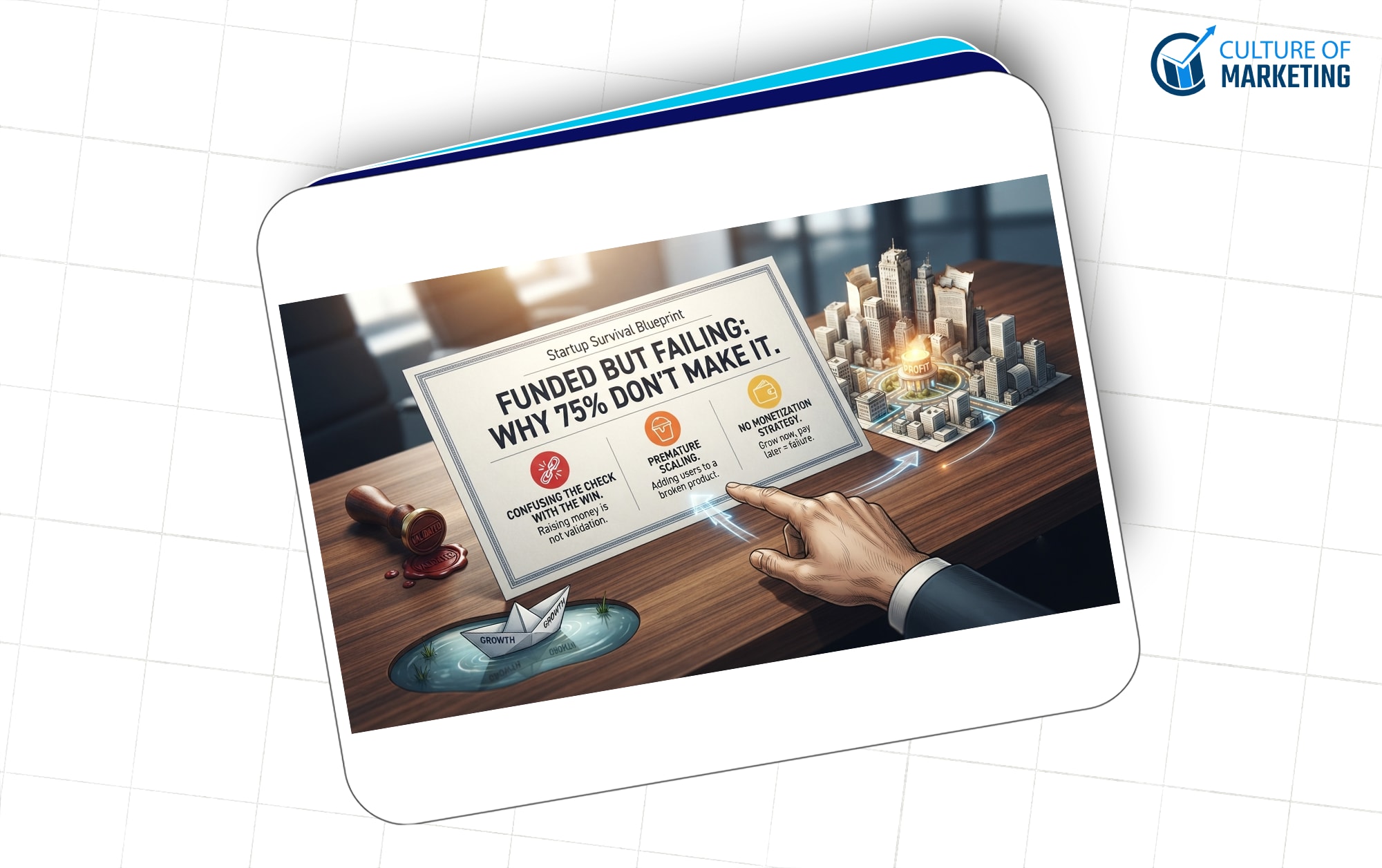
Roughly 75% of venture-backed startups end up failing despite significant financial backing. That's not a typo. Three out of four companies that actually convinced investors to write them a check still don't make it. So what's actually going wrong?
They Confuse the Check With the Win
I think this is where it starts for most founders, and I get it. Raising money is genuinely hard. The rejection, the pitches, the revisions, the waiting — it's exhausting. So when a term sheet finally lands in your inbox, your brain does something dangerous: it tells you that you've won.
You haven't won. You've bought yourself more time to figure out if you can win.
Investors are making a bet on potential. That's it. They're not your customers. They're not confirming that the market wants what you're building. They're saying, "We think there's a chance here." That's very different from actual validation.
But founders who've just closed a round don't always feel that distinction. They feel momentum. They feel credibility. And that feeling pushes them to start spending — on headcount, on tools, on branding — before they've answered the most important question of all: does anyone actually want this thing?
Nobody Wanted the Product — And They Built It Anyway
I've looked through a lot of startup post-mortems over the years. The one reason that keeps showing up at the top of the list, over and over again, isn't a cash problem or a people problem. It's a demand problem.
Founders build things nobody asked for.
It sounds almost too simple to be the leading cause of failure. But it happens constantly, and here's why: founders are usually in love with the solution, not the problem. They get excited about the tech, the design, the cleverness of the product. They talk to a few friends, get some enthusiastic nods, maybe run a small beta. And then they build.
What they skip — and this is the part that kills companies — is the honest, uncomfortable, sometimes humbling work of figuring out whether real people will pay real money to solve this particular problem in this particular way. Not your friends. Not your co-founder. Not the investors who just funded you. Random strangers with a problem and a credit card.
When you have funding, you can build faster. The problem is that faster building just means you find out sooner that the market doesn't care — but by then, you've already burned six months and half a million dollars getting there.
The Money Gets Spent as It'll Never Run Out
There's a psychological thing that happens when a large sum of money hits a company account. It feels permanent. It feels like a buffer between you and reality. It isn't.
I've watched founder after founder do the same thing in the months following a raise: they start spending in ways that feel justified in the moment but are quietly catastrophic over time. A Salesforce contract because "we'll need it eventually." A PR agency, because "now we can finally get some press." A full-time office because "the team deserves a real space."
None of these things is inherently wrong. All of them together, before the company has proven it can generate revenue, is a slow-motion disaster.
Cash flow mismanagement is one of the most consistently deadly problems in funded startups — not because founders are careless with money, but because they're optimistic about how fast things will move. They believe the next milestone is closer than it is. They assume revenue will arrive before it does. They underestimate how long it takes to hire well, onboard people, and actually execute.
And then one morning, someone pulls up the runway spreadsheet and realizes they have four months left. That's when the panic begins.
They Started Scaling Before They Had Anything Worth Scaling
Here's a scenario I want you to sit with for a second.
You've got a product that's sort of working. Early users seem happy-ish. The retention isn't perfect, but it's not terrible. You've got some word-of-mouth. The investors are asking about growth, and you want to show them something.
So you hire five salespeople. You spend $80,000 on performance marketing. You open up a second market.
What you just did is take a leaky bucket and pour more water into it faster. The leaks are still there. They're just bigger now.
This is premature scaling, and it's genuinely one of the most seductive traps in startupland because it feels like the right move. Investors want growth. The board wants growth. You want to feel like things are moving. So you push before you're ready.
But scaling amplifies what's already there — good and bad. If your onboarding is broken, more users just means more people experiencing a broken onboarding. If your support process is a mess, more customers just means a bigger mess. The problems don't get solved by growing through them. They multiply.
The startups that get this right are the ones patient enough to get boring things right before they get big.
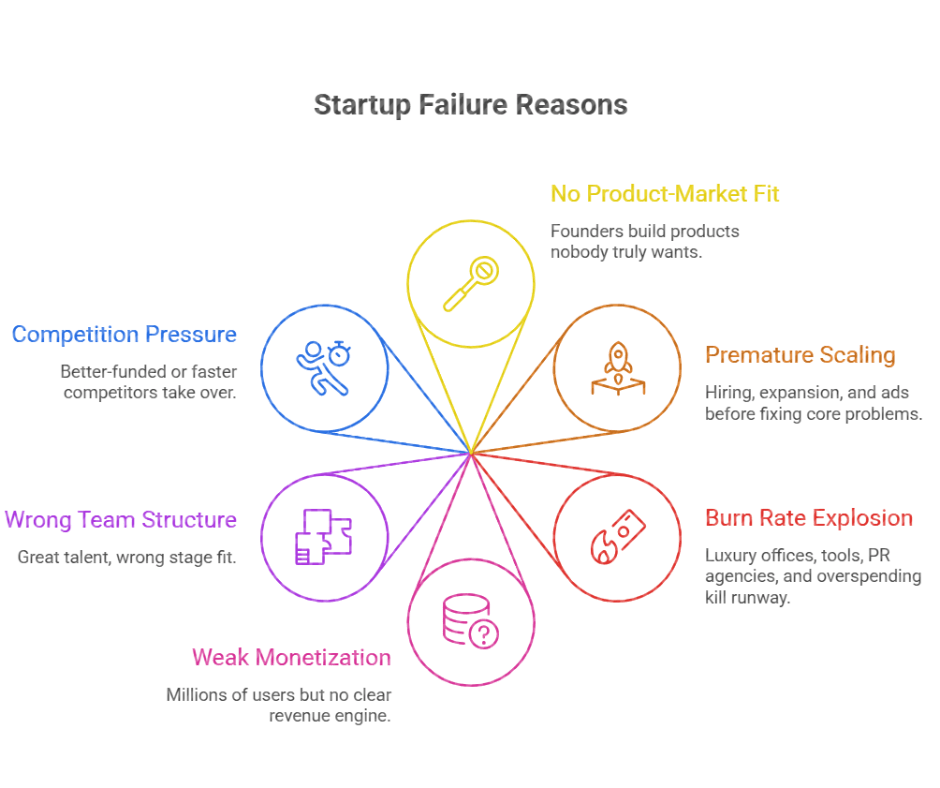
The Team Was the Wrong Team for This Stage
I want to be careful here because I'm not talking about smart people or talented people. Most founding teams are full of both. What I'm talking about is fit — the right skills for the right stage of a company.
A technical founder who can build a world-class product but has never sold anything in their life will eventually hit a ceiling. A hustler who can close deals but doesn't understand the product well enough to know what to promise will create a different kind of problem. The team dynamics that work at five employees completely fall apart at fifty.
There's research that backs this up in an uncomfortable way. Studies on startup failure have found that the competency gaps most closely associated with failure weren't technical gaps at all. There were customer-orientation gaps and market-research gaps. Founders who didn't deeply understand who they were building for, and why those people would pay for it, were the most likely to fail — regardless of how technically brilliant the product was.
After funding, the team's problems tend to compound too. Early hires shape culture in ways that are very hard to undo. The wrong VP of Sales can poison your revenue strategy for a year before you admit it. A head of product who doesn't believe in talking to customers will build a beautifully useless roadmap. These aren't small problems. They're company-defining ones.
The Competition Showed Up — and It Came Prepared
Nobody likes to think too hard about competition when they're in the middle of building. I understand that. There's something about constantly watching what competitors are doing that can feel paralyzing, or like you're defining yourself relative to someone else instead of creating something new.
But ignoring competition entirely is a form of wishful thinking that funded startups can't afford.
The moment you announce a raise, the people in your space notice. The incumbent with fifty times your resources suddenly has a reason to care about you. The other well-funded startup in the same category sees you as a direct threat. And new entrants read the same market signals you did and decide they want a piece too — sometimes with a better price, more connections, or a leaner operation.
About one in five startup failures comes down to being out-competed. And in most of those cases, the competitive pressure didn't appear out of nowhere. It was visible. It was just ignored for too long.
Building a defensible business — through real relationships, proprietary data, network effects, or brand trust — takes time and deliberate effort. As we've explored in Ai Content is Flood Killing Brand Trust, lasting competitive advantage comes from earning genuine trust—not simply producing more content or chasing short-term visibility. You can't bolt it on after the threat arrives. It has to be part of how you build from the beginning.
They Never Figured Out How to Actually Make Money
This one is almost embarrassing to write, and yet here we are.
Nearly a third of startups fail because they never develop a real monetization strategy. Not because they were lazy or naive — but because in the early stages, the pressure was on growth metrics: users, signups, engagement, monthly activities. Revenue was always the next thing. Something to figure out "once we have scale."
The problem is that scale and revenue aren't automatically connected. You can have millions of users and no clear way to convert that attention into dollars. And when the funding runs out, "we have great engagement" doesn't pay salaries.
Investor patience for revenue-free growth has shortened dramatically over the past few years. The era of "grow at all costs, and we'll figure it out" is largely over. What replaces it is discipline — knowing early on how you'll charge, who'll pay, and what the unit economics actually look like.
"We'll monetize later" is one of the most dangerous sentences a founder can say. Because later always comes. And it usually comes at the worst possible time.
So What Does Survival Actually Look Like?
The startups that make it through funding and come out the other side aren't usually the ones with the best pitch deck or the most impressive founding team on paper.
They're the ones that stayed obsessively close to their customers. That kept spending tight even when it felt unnecessarily cautious. That asked hard questions about whether things were actually working before they doubled down. They hired slowly, thought carefully about culture, and weren't afraid to admit when something wasn't working.
They treated the funding as what it actually is: a tool. Not a trophy. Not proof that they've figured it out. A tool for doing more testing, more learning, and more building toward something that actually lasts.
The check hits the account, and the real work begins. The founders who understand that on Day 1 are the ones still around to talk about it.