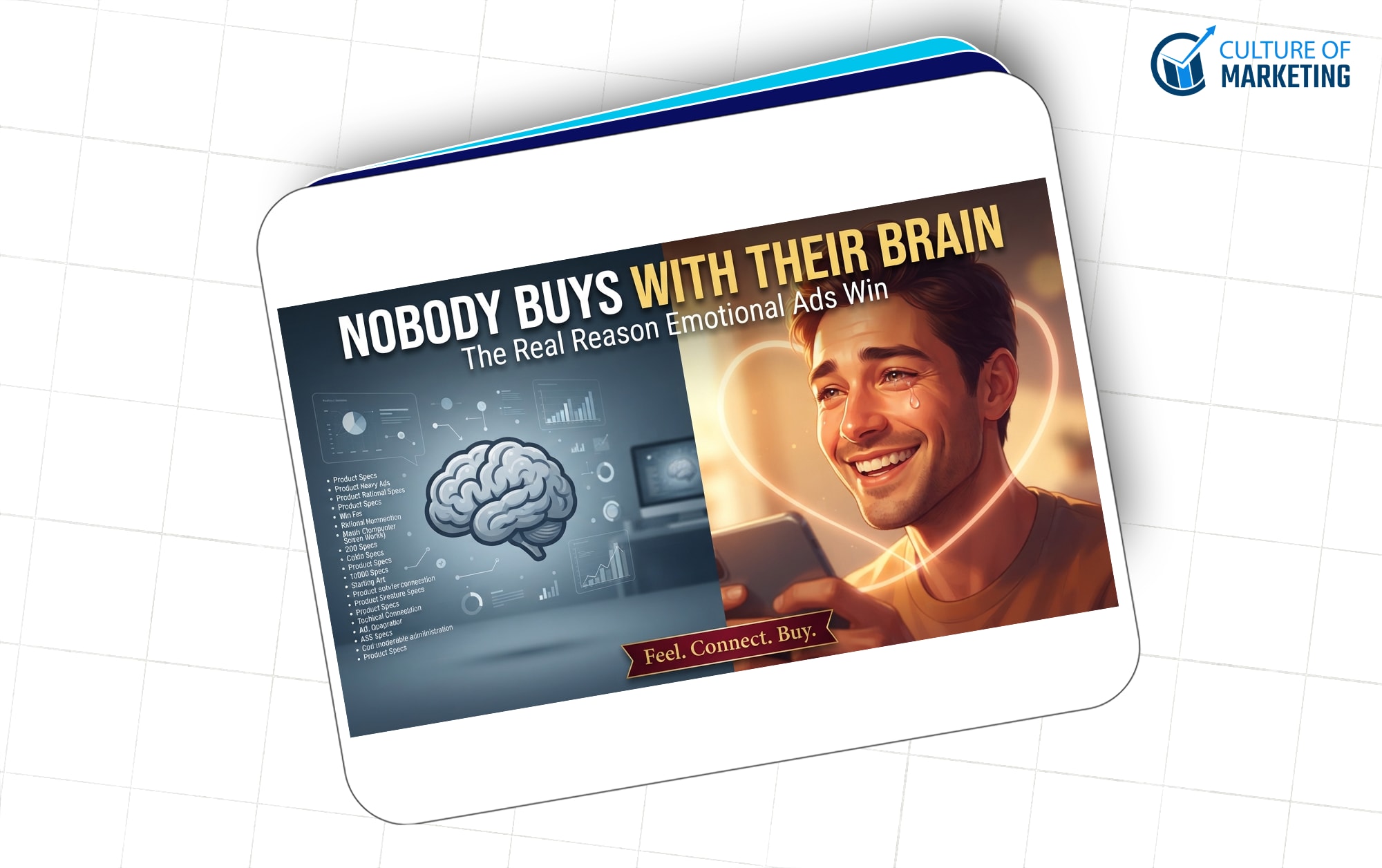
The Real Reason Emotional Ads Always Win
Think about the last thing you bought that you didn't need.
Not groceries. Not a bill payment. Something you wanted — a jacket, a gadget, a subscription, something you saw advertised somewhere, and just. ended up with. Now try to remember why you actually bought it.
If you're being honest, the real answer probably isn't "because the specs were superior" or "because the price-to-value ratio was optimal." It's something fuzzier than that. It felt right. You liked the vibe. Something about it just connected with you in a way that's hard to explain cleanly.
That feeling you're struggling to articulate? That's the whole game. That's what emotional advertising is: engineering, deliberately and carefully, every single time it works on you.
And it works on you more than you think.
The Logical Purchase Is Mostly A Story We Tell Ourselves
There's a researcher named Antonio Damasio who spent years studying patients with damage to the parts of the brain that process emotion. These patients were, in most measurable ways, completely normal. Intelligent, articulate, capable of complex reasoning.
But they couldn't make decisions.
Simple ones. What to eat for lunch. Which appointment slot to pick? Choices that you and I make without thinking become genuinely paralyzing for them. And the reason, as Damasio eventually worked out, is that decision-making isn't actually a logical process. It's an emotional one. Logic helps you evaluate options. Emotion is what makes you actually choose.
When marketers talk about emotional advertising, they're not talking about a clever trick to bypass your rational mind. They're talking about engaging the actual mechanism that produces decisions in the first place. The "rational" purchase you think you're making is almost always an emotional conclusion dressed up in logical justification after the fact.
You decided you wanted the MacBook. Then you found the reasons why it made sense.
What Emotional Ads Actually Do To You
The interesting thing about effective emotional advertising is that it rarely talks about the product directly. At least not at first. It talks about something you already care about — family, belonging, achievement, fear of missing out, the desire to be seen a certain way — and then quietly associates the product with those feelings.
Think about how this plays out in practice:
The Google "Reunion" ad — two childhood friends separated by the India-Pakistan partition, reconnected decades later through a grandchild using Google search. Nobody in that ad is talking about search algorithms or server speeds. You're crying. And somehow you feel warmth toward a search engine.
Nike's "Just Do It" campaigns — they're not selling shoes. They're selling the identity of someone who pushes through. Who doesn't quit. Who gets up early and does the work. The shoe is almost incidental. What you're buying is the feeling of being that person.
Apple's "1984" commercial — one minute of pure cinematic tension that said almost nothing about the computer it was selling. What it said was: buying this makes you a rebel. The nonconformist. The person who thinks differently. That positioning built a religion, not just a customer base.
None of these ads won because of product features. They won because they made you feel something and then attached the brand to that feeling so cleanly that one started triggering the other.
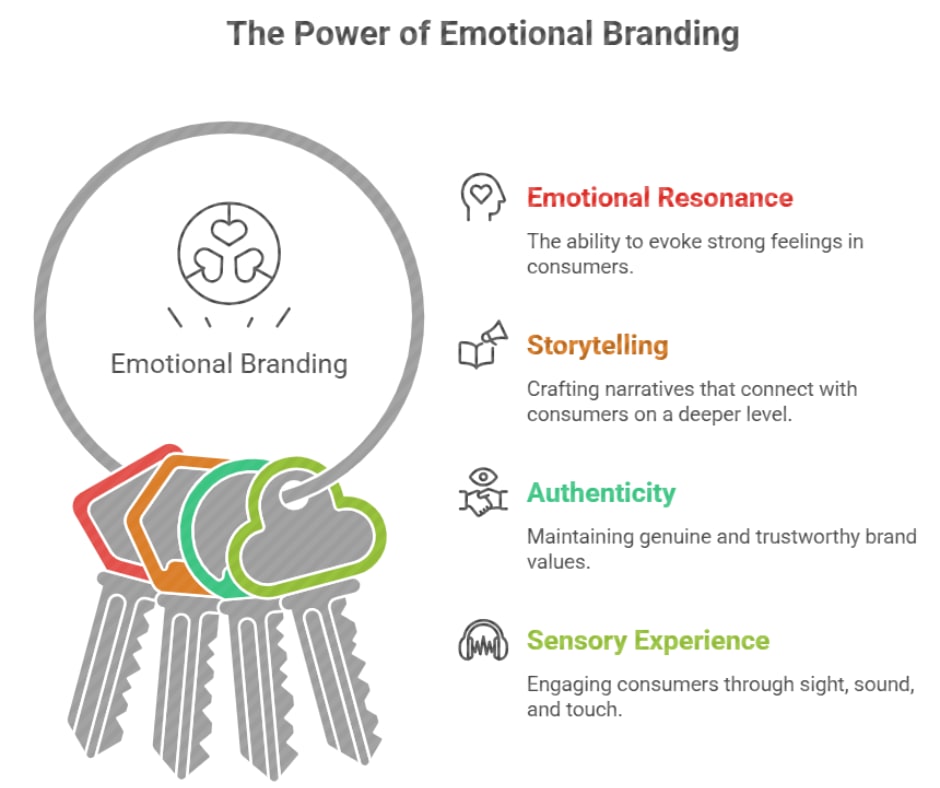
The Science Part — Because It's Actually Fascinating
There's real research behind why this works and it goes deeper than "emotions influence decisions."
Studies using brain imaging have shown that when people evaluate brands, the parts of the brain associated with emotion and personal identity activate significantly more than the parts associated with information processing. You're not analyzing a brand. You're relating to it the way you relate to a person — intuitively, emotionally, based on how it makes you feel about yourself.
A study by the Institute of Practitioners in Advertising looked at thousands of advertising campaigns and found that purely emotional campaigns outperformed rational ones by almost 2 to 1 in terms of profitability. Not engagement. Not recall. Actual business results. Understanding emotional advertising becomes much easier when you realize that modern digital platforms are constantly competing for one thing—your attention. In many ways, Your Brain is the Product, and every click, scroll, and emotional reaction becomes part of that business model.
Here's what makes emotional ads stick specifically:
Emotional experiences are encoded differently in memory — they get stored with more detail and retrieved more easily than neutral experiences. An ad that makes you feel something is an ad you actually remember.
Emotion triggers sharing — content that produces a strong emotional response gets shared at dramatically higher rates than content that's merely informative. Awe, amusement, inspiration, even sadness — these spread. Useful-but-neutral doesn't.
Feeling precedes thinking — the emotional response to an ad happens in milliseconds, before conscious evaluation begins. By the time your rational mind is considering the product, your emotional mind has already formed a preference.
Why Rational Ads Keep Getting Made Anyway
If emotional advertising consistently outperforms rational advertising, why do so many brands still run ads that are basically just a list of features?
Honestly? Because emotional advertising is harder to defend in a boardroom.
When someone asks why you spent the budget on a two-minute film about a grandfather teaching his granddaughter to cook instead of a campaign highlighting your product's five key advantages — the emotional answer is hard to quantify at the moment. "This will make people feel something" is a harder sell internally than "this communicates our three differentiating features."
Feature-based advertising is also easier to make. You know what you're saying. You can check a box for every claim. Legal can review it clearly. There's less ambiguity and less creative risk.
Emotional advertising requires trusting that the feeling you're creating will translate into the behavior you want — and that trust is uncomfortable for a lot of organizations, especially ones run by people who think of marketing as a logical exercise.
So the rational ad keeps getting made. And it keeps underperforming. And the cycle continues.
The Brands That Get This — And What They Do Differently
The brands that consistently win on emotion aren't doing it by accident. There are specific things they understand that most brands don't act on even when they know them intellectually.
They lead with the human truth, not the product truth. Before they talk about what they make, they identify something real and universal about the human experience their product touches — and they start there. The product is the solution to a human feeling, not a list of specifications.
They're willing to be specific enough to be real. Generic emotion doesn't work. "Feel inspired" is too broad to connect with anyone. The brands that do this well find the specific moment, the specific relationship, the specific fear or hope that their audience actually carries around — and they name it precisely enough that people feel seen.
They understand that people don't want to be told what to feel. The worst emotional advertising is the kind that's obviously trying to manipulate you — the swelling strings, the slow-motion meaningful looks, the message that's so on-the-nose it feels like homework. The best emotional advertising makes you feel something without you quite realizing why. It earns the emotion rather than demanding it.
They connect the emotion to an identity, not just a moment. The most durable emotional advertising isn't just making you feel good in the moment — it's associating the brand with who you want to be. That association, built consistently over time, is what creates the kind of brand loyalty that survives price competition and product gaps.
What This Means If You're Actually Making Ads
If you're running campaigns for a brand — big or small — and you're still leading with features, you're not being rigorous. You're being comfortable.
The question that actually matters isn't "what does our product do?" It's "how does our customer want to feel, and how does our product connect to that feeling?" Those are different questions, and they produce radically different work.
You don't need a massive production budget to do emotional advertising well, either. Some of the most emotionally effective content in the last few years has been lo-fi, raw, and human precisely because it felt real instead of produced. The emotion doesn't come from the production value. It comes from the truth you're telling.
Start with the human moment. Find the feeling that's already there in your customer's life — the anxiety, the hope, the small joy, the thing they want to be true about themselves — and figure out where your product honestly lives in that picture. Then show that. Don't explain it. Show it.
The Honest Bottom Line
Logic tells people what to think about your product. Emotion tells them how to feel about your brand. And people act on how they feel far more reliably than they act on what they've concluded.
This isn't a loophole in human psychology. It's not a manipulation technique that only works on unsophisticated audiences. It's just how people are built — all people, including the ones who consider themselves rational decision-makers, including the ones reading a marketing blog who know exactly how this works.
The ads that make you feel something win. Not sometimes. Consistently, measurably, over time. The data on this is not ambiguous.
The only real question is whether you're going to use that knowledge or keep making ads that explain things clearly and wonder why nobody cares.