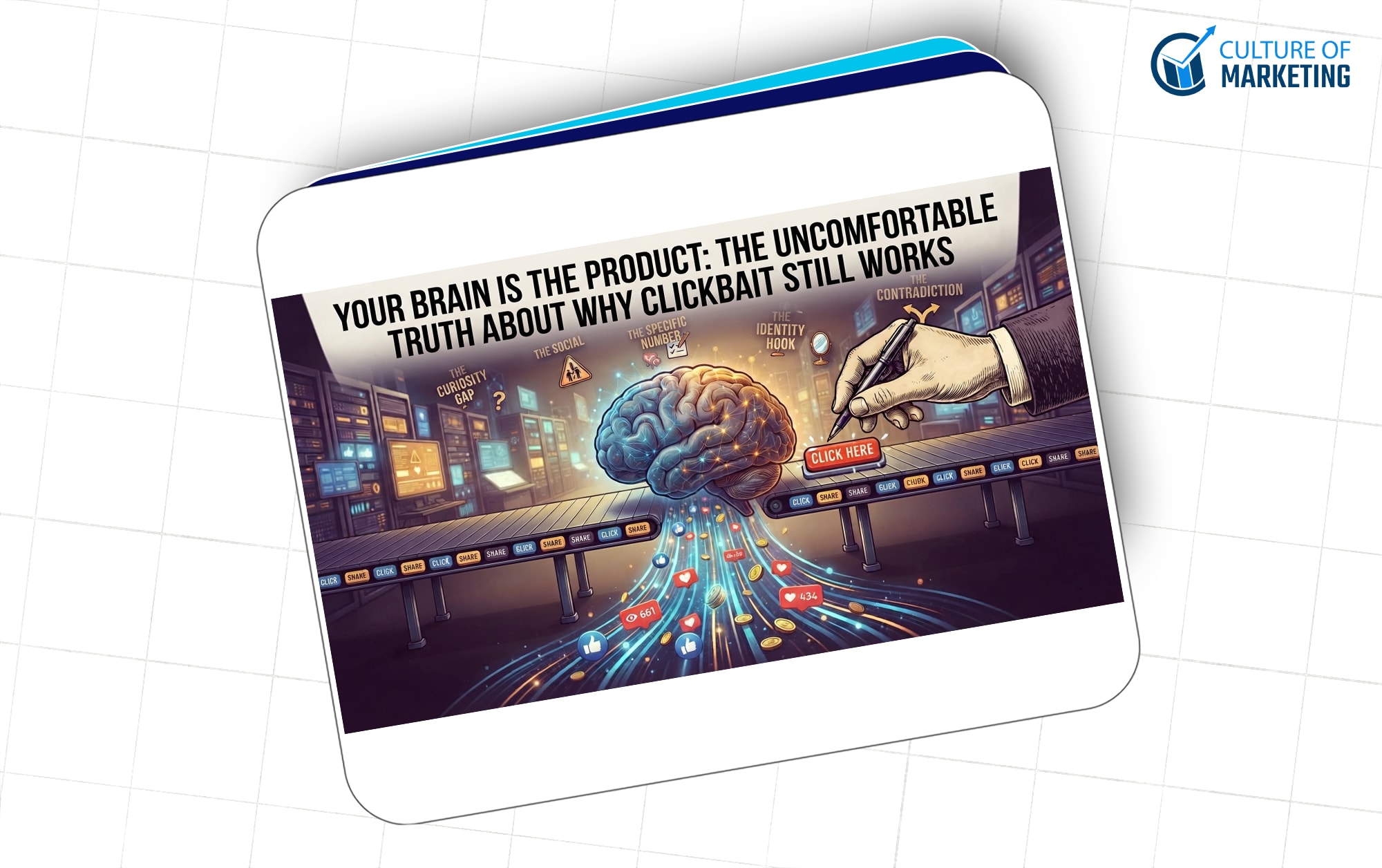
The Uncomfortable Truth About Why Clickbait Still Works
I clicked on something embarrassing last week.
I won't tell you what it was exactly, but I'll say it involved a headline about a celebrity I don't even particularly care about, a promise that "the full story will shock you," and approximately four minutes of my life that I will never get back.
The worst part isn't that I clicked. The worst part is that I knew — like actually consciously knew while my finger was moving — that it was going to be disappointing. And I clicked anyway.
That's been bothering me since. Not in a deep existential way, just in that low-grade annoying way where something keeps coming back to you because it doesn't quite make sense. I consider myself a reasonably critical consumer of media. I've read enough about how this stuff works to know the tricks. And still. Still.
So I want to actually talk about this honestly — why clickbait works, why it keeps working, and why the "audiences are getting smarter" take that media people keep repeating is, at best, incomplete.
First — Can We Stop Pretending We're Above It
There's this thing that happens whenever clickbait comes up in conversation. Everyone nods along about how manipulative it is, how they never fall for it, how it only works on people who aren't paying attention.
And then those same people go home and spend forty minutes on a website they clicked into from a Facebook post that said: "She had no idea what was about to happen."
I'm not judging. I'm included in this. We're all included in this.
The reason I want to name it upfront is that the "clickbait only works on other people" belief is exactly what makes it so effective. When you're confident you're immune to something, you stop defending against it. You don't notice the moment it's happening. And then you're four articles deep into a website you've never heard of, reading about a topic you don't care about, wondering how you got there.
That's not stupidity. That's just how brains work. And until we're honest about that, we can't have a real conversation about why this stuff is still everywhere fifteen years after people started declaring it dead.
Your Brain Has a Bug — And Clickbait Found It
Here's the actual explanation, and it's less about media literacy and more about basic human neurology.
There's a concept in psychology called the information gap theory. The short version is this — when your brain becomes aware that there's a gap between what you currently know and what you could know, it experiences that gap almost like a mild itch. Not painful. Not urgent. Just. unresolved. And unresolved things bother us. We're wired to close loops.
"The one habit that separates successful people from everyone else."
You don't know what the habit is. Your brain now has an open loop. The click closes the loop. It's not really a decision — it's more like scratching something that's itching.
And here's the genuinely uncomfortable part about this. Knowing that it's happening doesn't make you meaningfully more resistant to it. You can be fully aware that a headline is engineered to create an information gap in your brain, you can be annoyed about it, you can feel slightly manipulated — and still click. Because the itch is still there regardless of whether you understand why it's there.
That's the thing that clickbait figured out, probably more by accident than design in the early days, and that every serious publisher and content creator now understands explicitly. You're not targeting someone's judgment. You're targeting something that runs underneath judgment.
The Patterns That Show Up Everywhere — For Good Reason
Once you see the specific formulas, you notice them constantly. Not because publishers are being lazy and copying each other, but because these particular structures work reliably across different audiences, different topics, and different platforms.
The curiosity gap — "What doctors actually eat for breakfast" withholds the answer just long enough to make you need it. The gap is the whole mechanism.
The social threat — "Are you making this mistake?" implies that other people know something you don't. Humans are social animals, and social animals are acutely sensitive to being behind the group. This one hits hard even on people who think they don't care what others think.
The specific number — "7 things" feels more credible than "things." It implies someone sat down and actually counted. Structure suggests effort. Effort suggests reliability. None of that may be true, but the brain infers it anyway.
The identity hook — "What your morning routine says about your personality." People will click almost anything that promises to tell them something about themselves. We're fascinated by ourselves in a way that never really gets satisfied.
The contradiction promise — "Why working harder is actually making you less productive." This one tells you your current understanding is wrong, which bothers people more than they expect. We don't like being incorrect. We want to correct it.
None of this is random. Every single pattern maps onto something the brain was already doing before the internet existed. Clickbait didn't create these vulnerabilities — it just found them and built a business model around them.
Why It Hasn't Died And Honestly Probably Won't
Every couple of years, someone writes a piece about how clickbait is finally dying. Audiences are getting more sophisticated. Platforms are cracking down. Trust is the new currency. And look — some of that is true.
The Upworthy era stuff is mostly gone. The headlines were so disconnected from the actual content that clicking felt like getting scammed — that version got punished hard. Facebook changed its algorithm, traffic collapsed for the worst offenders, and a bunch of those sites folded or pivoted. Real consequences happened.
But here's what actually occurred. The lazy version of clickbait died. The version that was so obviously manipulative that it eroded trust fast — that one got filtered out.
What survived got smarter. What survived learned that the gap between the headline promise and the content payoff couldn't be too large or people felt cheated. So publishers narrowed the gap. They started actually delivering on the curiosity they created. The headline still does the psychological work of making you need to click — but the content on the other side got better because it had to.
That's not clickbait dying. That's clickbait adapting. An adapted clickbait is honestly harder to argue against because you can't call it manipulative when it's actually giving you what it promised.
YouTube figured this out better than anyone. The thumbnail with the wide eyes and the bold text and the dramatic arrow pointing at something — it creates curiosity, and then the video actually addresses whatever it's pointing at. Is that clickbait? Technically yes. Does it feel like a scam? Usually no. That's the evolved version, and it works incredibly well.
The Platform Angle That Nobody Talks About Enough
Here's something worth saying directly. Platforms don't actually want clickbait to disappear.
Every major platform — Facebook, YouTube, Twitter, TikTok — runs on engagement. Clicks, time spent, shares, comments. These numbers drive advertising revenue, which is how every one of these companies makes money. And clickbait, whatever you think of it, drives engagement. That's just factually true.
When platforms crack down on clickbait, they're not trying to eliminate the psychology — they're trying to filter out the content that's so bad it makes users trust the platform less, which eventually hurts long-term engagement numbers. The goal isn't zero clickbait. The goal is the optimal amount of clickbait that keeps people scrolling without making them feel consistently ripped off.
Which means every creator and publisher on these platforms is operating inside an incentive structure that quietly rewards them for figuring out exactly how clickbait-y they can be without crossing the line. No clickbait. Not maximum clickbait. The sweet spot.
That's the environment. Knowing it exists doesn't get you out of it — it just helps you make more deliberate choices inside it.
If You're Making Content — Here's What This Actually Means
Look, I'm not going to tell you to write misleading headlines because it'll hurt your trust long term, and you already know that. But pretending psychology doesn't exist and writing headlines like a university press release isn't the answer either.
The version that actually works — the one that builds clicks and audience simultaneously — is pretty simple in theory and harder in practice.
You make a real promise. You keep it. The headline creates genuine curiosity about something genuinely worth knowing, and the content delivers on that curiosity without making the reader feel like they got played.
Write five headline options for every piece, not one. The difference between a mediocre headline and a great one is rarely obvious on the first try.
Be specific in a way that feels useful before the click — "why your email open rates drop after list growth" tells me more and makes me more curious than "email marketing tips."
Tease the insight without hiding it completely — give enough that I believe you have something real to say, withhold just enough that I still want to click.
Test what actually performs and be honest with yourself about what the data is telling you.
The people doing this well aren't the ones who reject psychology. They're the ones who understood it well enough to use it without abusing it. The same principle applies beyond content marketing. Many professionals unknowingly develop habits that damage their credibility and long-term growth without realizing it. Understanding these hidden mistakes can help you avoid The Silent Career Killer that holds many talented people back.
The Part That Actually Matters
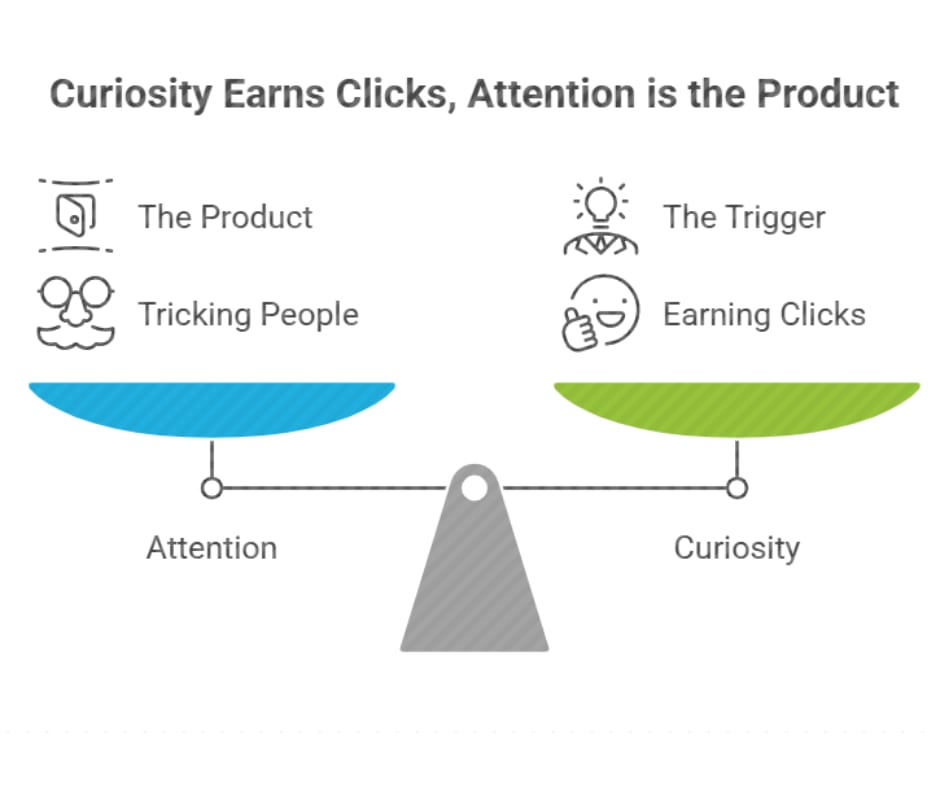
Clickbait keeps working because the brain keeps working the same way it always has. That's not changing. The information gap is real, the social threat response is real, the loop-closing instinct is real — and no amount of media literacy education has meaningfully changed how those things operate at the neurological level.
What does change is the relationship between publishers and audiences when trust is burned too many times. That's the actual limit on how far this goes. Not sophistication. Not awareness. Just — eventually, people stop trusting a source that keeps disappointing them.
Which means the sustainable version of all this is the one where the curiosity you create is real, and the payoff you deliver is worth it.
That's not a moral argument. That's just a practical one. The clickbait that lasts is the clickbait that earns the click. Everything else is just burning through an audience faster than you can replace them.
And given how hard it is to build an audience in the first place, that seems like a bad trade.