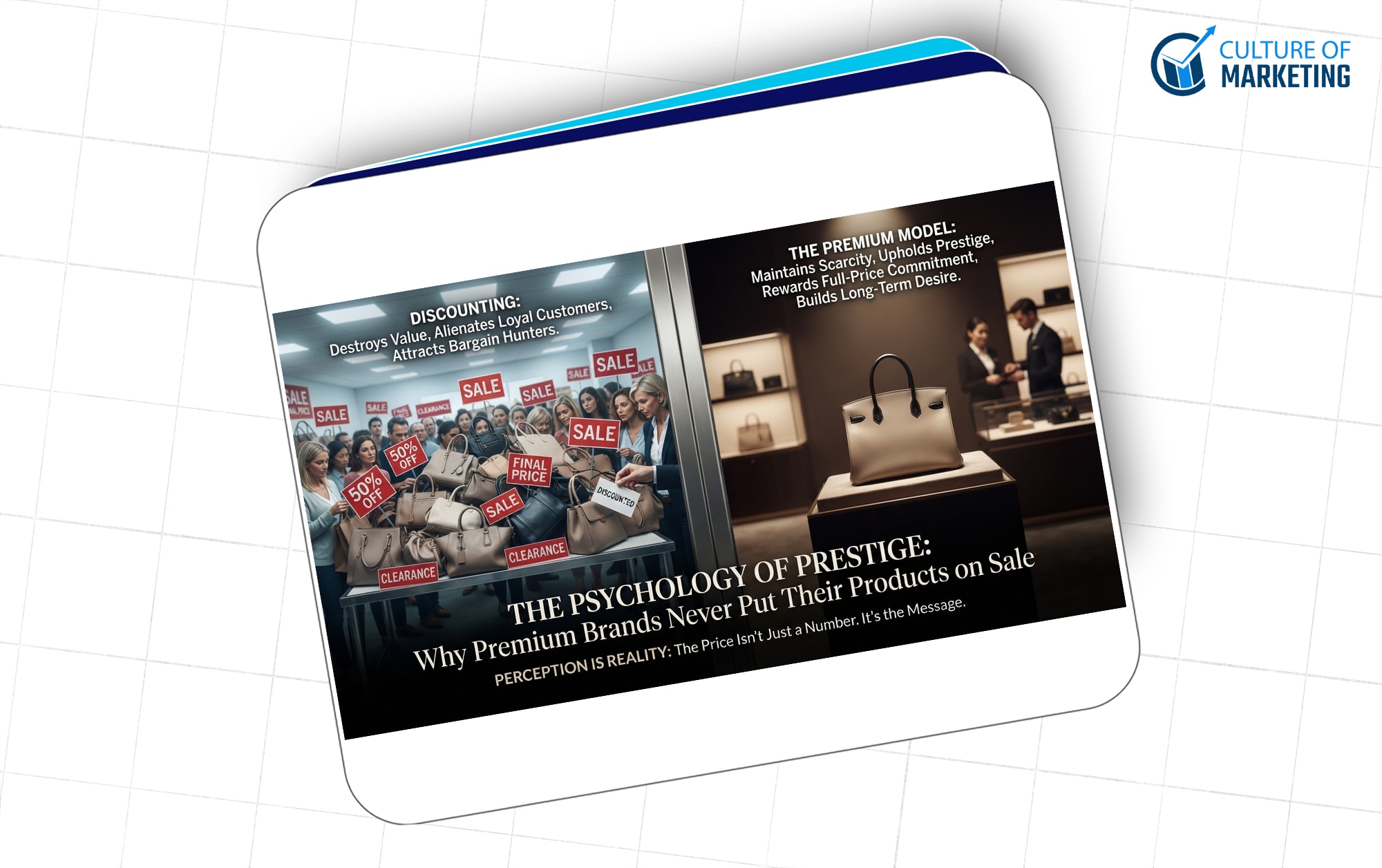
Why Premium Brands Never Put Their Products on Sale
You've never gotten a discount code from Hermès. There's no loyalty points program at Rolex. Louis Vuitton has never once sent you a "we miss you, here's 20% off" email.
And honestly? That's not an accident. It's the whole strategy.
Most people look at luxury brands and think the no-discount rule is just arrogance, or some old-fashioned idea about keeping up appearances. But if you dig into how these brands actually think about pricing, you realize pretty quickly — they're not avoiding discounts because they're too proud. They're avoiding discounts because a discount would literally destroy what they've spent decades building.
The Price Isn't Just a Number. It's the Message.
Here's something that takes a second to really sink in: for a premium brand, the price tag is part of the product.
When someone buys a $12,000 Cartier bracelet, they're not just buying jewelry. They're buying into a world that most people don't have access to. The price is what creates that world. It's the velvet rope. It's the reason walking into a Cartier store feels different from walking into a mall jewelry kiosk — even before you touch a single piece.
Take the price away, or even just temporarily lower it, and you've let everyone past the rope. The world you built stops feeling exclusive. And once that feeling is gone, it's incredibly hard to get back.
That's not marketing fluff. That's just how human psychology works. We assign value to things partly based on what they cost. A $40 bottle of wine tastes better to most people than the same wine labeled at $12 — there's actual research on this. Premium brands figured this out a long time ago and built their entire model around it. The same principle applies beyond products — even a strong (Personal Branding) is built around perception, positioning, and the value people associate with a name.
What Actually Happens When a Luxury Brand Discounts
Let's say a high-end brand panics during a slow quarter and runs a sale. Maybe 25% off, just to clear some inventory and hit their numbers. Here's what actually unfolds — not in marketing theory, but in real consumer behavior.
Customers learn to wait. The moment a shopper sees that brand on sale once, a little switch flips in their brain. "Oh, they do discounts." Now every time they want to buy something, there's a voice in the back of their head saying: just wait. Your full-price conversion rate never fully recovers.
Loyal customers feel burned. Think about the person who bought that bag last month at full price. They're not just disappointed — they're quietly furious. They feel like they got played. Those customers, the ones who believed in you enough to pay full price without blinking, are the hardest to win back once you've broken that trust.
You attract the wrong crowd. A sale pulls in bargain hunters. People with no real connection to the brand, who buy once because the price dropped into their range and disappear the moment it goes back up. They don't become loyal customers. They don't evangelize. They just move on to the next deal.
The brand starts to feel. normal. And "normal" is the absolute last thing a premium brand wants to be. Exclusivity isn't just about price — it's about the feeling that you're part of something most people aren't. The second a brand starts showing up in the sales section, that feeling evaporates.
Chanel Did the Opposite — and It Worked Perfectly
During COVID, when basically every retailer on earth was slashing prices and running desperate promotions just to survive, Chanel did something that seemed almost insane at the time.
They raised their prices.
Multiple times. Significantly. While the world was in economic freefall, Chanel's bags got more expensive. And the reaction? Waitlists got longer. Resale prices climbed. The brand became more desirable, not less.
It sounds counterintuitive until you understand what was actually happening. By raising prices in a moment when everyone else was discounting, Chanel sent a clear signal: we are not worried, we are not desperate, and this brand is not something that bends to circumstance. That kind of confidence is magnetic. People want to be associated with something that doesn't flinch.
Contrast that with brands that did discount during that period. Many of them saw short-term revenue bumps followed by long, painful fights to reclaim their premium positioning. Some never fully did.
Scarcity Isn't a Trick. It's a Philosophy.
There's a version of scarcity that's cynical — artificially limiting supply just to drive up demand. But the best premium brands practice something different. They build genuine scarcity into the DNA of what they make.
Hermès doesn't put Birkin bags on a shelf for anyone to buy. You have to develop a relationship with a sales associate. You spend time in the store, you build history, and eventually — maybe — you get offered one. The whole process is designed to make the bag feel like something you earned, not something you bought.
That's not about being difficult. It's about making the customer feel like they're part of an inner circle that actually means something.
When you discount, you undo all of that. A sale says: we have too much and not enough demand. Scarcity says: demand will always outpace what we're willing to make. One of those is a premium brand. The other is just a store.
The Full-Price Customer Is Everything
This is the part that a lot of brands intellectually understand but emotionally struggle with — especially when sales are soft, and the pressure to hit quarterly numbers is real.
Your full-price customer is not just your most profitable customer. They're your brand's immune system.
These are the people who walked in without a coupon, without a sale notification, without any financial nudge whatsoever — and decided your product was worth exactly what you said it was worth. That's a level of belief that's genuinely rare. They're not just buyers; they're believers.
When you discount, you're essentially telling those people: we didn't actually need you to believe in us at full price. Anyone willing to pay $X during a sale would have been fine. That's a brutal message to send to your most loyal customers, even if you never say it out loud.
Over time, those customers drift. They don't make a big announcement about it. They just quietly start spending their money somewhere that still makes them feel like their conviction meant something.
So What Do Premium Brands Do Instead?
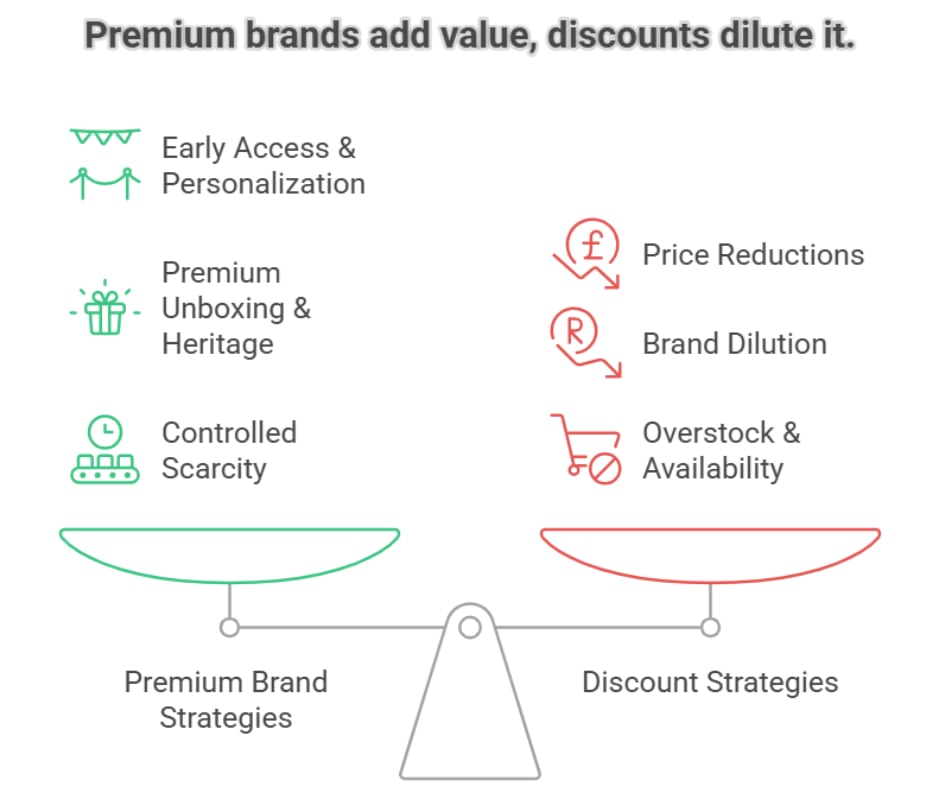
Not discounting doesn't mean ignoring the need to reward loyal customers or drive new ones. The smartest premium brands have just developed an entirely different toolkit — one that adds value without touching the price tag.
Early access over price breaks. Loyal customers get first access to new collections, private previews, or invite-only events. The reward is access, not a lower number.
Personalization that feels genuinely personal. Monogramming, custom fittings, handwritten notes, and personal shoppers who actually remember your preferences. These things cost the brand relatively little but make the customer feel irreplaceable.
The unboxing experience. A $300 skincare product that arrives in a beautiful matte box with tissue paper and a carefully chosen insert reinforces the premium decision at every touchpoint — not just at purchase.
Heritage storytelling. Brands like Rolex and Patagonia invest enormously in telling the story of how their products are made, what they stand for, and why they've lasted. When you understand the craft or the mission, the price doesn't feel like an obstacle. It feels like a fair exchange.
Controlled, genuine scarcity. Limited editions. Flagship-only releases. Collaborations with a waiting list. These keep demand healthily ahead of supply without a single markdown.
Every one of these strategies sends the same underlying message: you are valued, and this brand is worth what it costs. None of them requires dropping the number.
When Products Hold Their Value, That's the Real Signal
Here's a metric that tells you more about a premium brand's health than almost anything else: resale value.
When something you bought holds its price — or appreciates — in the secondary market, it stops being a purchase and starts being an asset. Certain Chanel bags, specific Rolex references, and limited Nike collaborations. These things trade above retail on the resale market, sometimes significantly above.
That's not luck. It's the direct consequence of a brand that has never conditioned the market to expect discounts. When buyers know a product will never be cheaper than what they paid, they stop waiting and start committing. The floor on value stays firm.
Discount once, and the resale market notices immediately. Collectors and resellers understand that a brand willing to go on sale will do it again. The certainty of future discounts destroys the floor. And once that floor drops in the secondary market, it sends a quiet but powerful signal to new buyers: this might be worth less than you think.
The Bottom Line
The brands that truly live in the premium tier aren't playing the same game as everyone else. They're not optimizing for this quarter. They're protecting something extremely difficult to build and almost impossible to rebuild once it breaks — the feeling that their brand is genuinely worth wanting.
Discounting might feel like a rational, responsible business decision in a tough month. And maybe in isolation, it even is. But in the premium world, perception is reality. And once customers perceive your brand as something that goes on sale — even once, even for a limited time — a little bit of the magic disappears.
The best luxury brands have understood this forever. That's why you'll never see a Hermès flash sale. And honestly, that's exactly why you still want one.