The Real Reason You Trust Big Brands
You know what's funny? Most people believe they're fairly adept at making rational decisions. Especially when it comes to spending money, they'll tell you they do their research, they compare options, they don't just fall for marketing.
And then they'll go buy the Nike shoes over a virtually identical pair from a brand they haven't heard of — and pay $40 more for them — without a second thought. That's not a knock on anyone. That's just how this works. And once you actually understand why it works, you start seeing it everywhere.
Your Brain Is Lazy. Big Brands Know This.
Not lazy in a bad way. Lazy in a survival way.
Your brain is constantly making hundreds of micro-decisions throughout the day, and it does not have the energy to think deeply about every single one of them. So it takes shortcuts. It looks for patterns. It asks itself — have I seen this before? Did it go okay last time? Cool, we'll do that again. Big brands have essentially hacked this process. They show up so consistently, in so many places, over such a long period of time, that your brain just... files them under "safe." Not great, not verified, not even necessarily the best option — just safe. Known. Low-risk. And when you're standing in a store aisle at 6 pm after a long day, low-risk wins almost every single time.
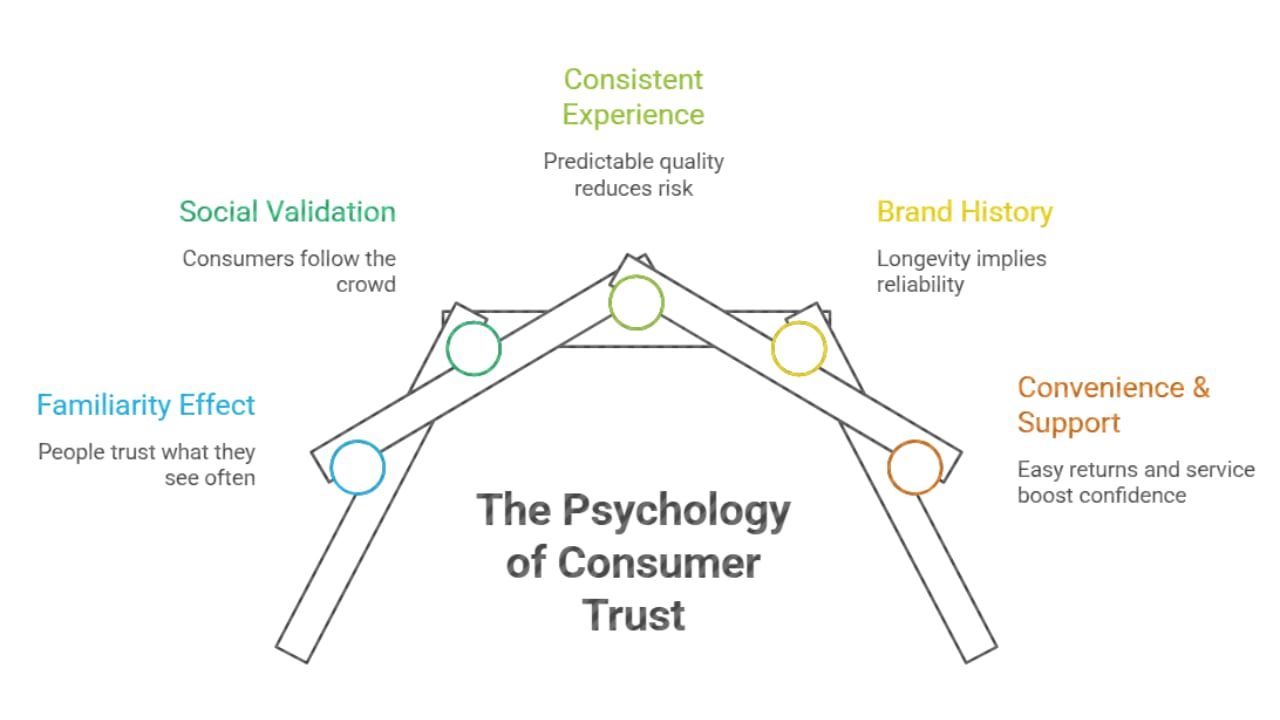
There's actual science behind this. Psychologists call it the mere exposure effect — the more you're exposed to something, the more positively you feel about it, even without any real interaction with it. You didn't choose to feel comfortable with Coca-Cola. You were just exposed to it so many times that comfort became the default.
Nobody Trusts a Stranger. Big Brands Don't Act Like Strangers.
Think about how trust actually works in real life.
You don't trust someone the first time you meet them. You trust them after they've shown up when they said they would, done what they said they'd do, and not surprised you in bad ways over time. Trust is just consistency witnessed repeatedly. That's genuinely all it is.
Big brands behave the same way — except they do it at a massive scale, across millions of touchpoints, for years on end. The Starbucks you walked into in Seattle feels the same as the one in Miami. The packaging on your Tide detergent looks the same as it did three years ago. The Apple Store in your city has the same vibe as the one in every YouTube unboxing video you've ever watched. None of this happens by accident. There are entire teams of people whose only job is to make sure nothing feels off.
And here's the thing — you don't consciously notice any of this when it's working. You only notice when it breaks. When a brand suddenly changes its logo and the internet loses its mind, or when a product quality dips and the reviews turn brutal overnight — that's the trust infrastructure cracking. People feel it viscerally even when they can't explain exactly why.
You Were Peer Pressured Into Most of Your Brand Loyalties
Here's the uncomfortable one. A huge portion of your brand preferences? You didn't actually form them yourself. They were formed for you by the people around you, over a long period of time, without anyone explicitly telling you what to think. Your parents used certain brands. Your friends in college swore by certain things. The people you follow online casually mention the same products over and over. The shows you watch feature certain cars, certain drinks, and certain laptops sitting open in coffee shop scenes. None of this feels like advertising. That's the point.
Social proof is the single most powerful trust mechanism big brands use, and it works precisely because it doesn't feel like marketing. It feels like observation. Like, "hm, everyone around me uses this, so it must be worth trusting." And then there's the sheer volume of it. You see that a product has 847,000 reviews on Amazon and an average of 4.6 stars, you don't read a single one, and yet somehow you feel better about buying it. That number just... does something to you. It signals that a crowd of people has already made this decision and doesn't regret it. And your brain says okay, good enough, let's go.
The Experience After the Sale Is Doing More Work Than You Think
This one doesn't get talked about enough. A huge part of why people trust big brands comes down to what happens after they hand over money. And the best brands have spent an enormous amount of time and money making sure that experience is smooth enough that you never really have to think about it.
Free shipping. Easy returns with no hoops to jump through. A customer service line that actually picks up. A tracking number that updates in real time. A clear, simple refund process that doesn't feel like you're filing a legal appeal.
These things sound so basic when you list them out. But think about the last time you tried to return something to a brand you'd never heard of, and the whole experience felt like fighting through fog. That experience didn't just frustrate you in the moment — it changed how you felt about that brand permanently.
Big brands figured out early that every painful post-purchase moment is a trust withdrawal. So they invested in making that entire experience feel effortless. And every time it goes smoothly, they earn a little more of your confidence back. Multiply that across millions of customers and years of interactions, and the trust compounds in a way that's genuinely hard to compete with.
Age Is a Cheat Code in the Trust Game
There's something almost irrational about the trust people extend to old brands. But it's real, and it makes sense when you think about it.
A company that's been around for 75 years has survived recessions, cultural upheaval, bad press cycles, lawsuits, competitive threats, and every kind of disaster you can name. That longevity is its own credential. It says — whatever this brand is doing, it's durable enough to still be here.
New brands don't have that. They can be objectively better in every measurable way — better product, better ethics, better price, better customer service — and still lose to a 100-year-old name simply because people haven't had enough time to watch them survive anything yet.
Legacy brands lean on this hard. "Since 1923." "The recipe hasn't changed." "Four generations of families." That's not just nostalgia. That's a trust argument dressed up as history.
Being Unavoidable Is a Strategy, Not a Coincidence
The last piece of this is the one that might sound the most obvious, but gets underestimated the most.
Big brands are everywhere. Not just in ads — in movies, in sports stadiums, in your phone's default apps, in the checkout line, in the recommendation your friend casually dropped into conversation. The interesting part is that advertising itself has changed dramatically — from the memorable campaigns people actually talked about to the endless stream of content competing for attention today. [Where did All the Good Ads Go?] explores exactly why that shift happened and what it means for brands trying to stay memorable. They occupy so much mental space that avoiding them would take genuine effort.
And that ubiquity creates a kind of passive authority. When something is everywhere, it feels important. When it feels important, it feels trustworthy. It's circular logic, but it's extremely effective circular logic. The brands that dominate your attention also dominate your trust — not because they've earned it in any particularly noble way, but because they were present long enough and loudly enough that trust became the path of least resistance.
Here's the Part That Should Actually Bother You a Little
Most of your brand trust was never really earned. It was manufactured through repetition, through other people's behavior, through frictionless experiences, through being old enough to feel stable, through showing up in so many places that familiarity became mistaken for quality. That doesn't mean big brands are bad. A lot of them genuinely deliver. But it does mean that the next time you default to the familiar name, it's worth asking — am I making this choice, or was this choice made for me a long time ago?
And if you're building something? Stop waiting to have a Nike-sized budget before you start thinking about trust. Consistency, reliability, social proof, and a good experience after the sale — none of those require a fortune. They require commitment. They require showing up the same way, every single time, until people stop having to think about whether they can count on you.
Because that's the moment trust actually happens. Not in the campaign. Not in the logo. In the quiet, repeated proof that you do what you say you'll do.