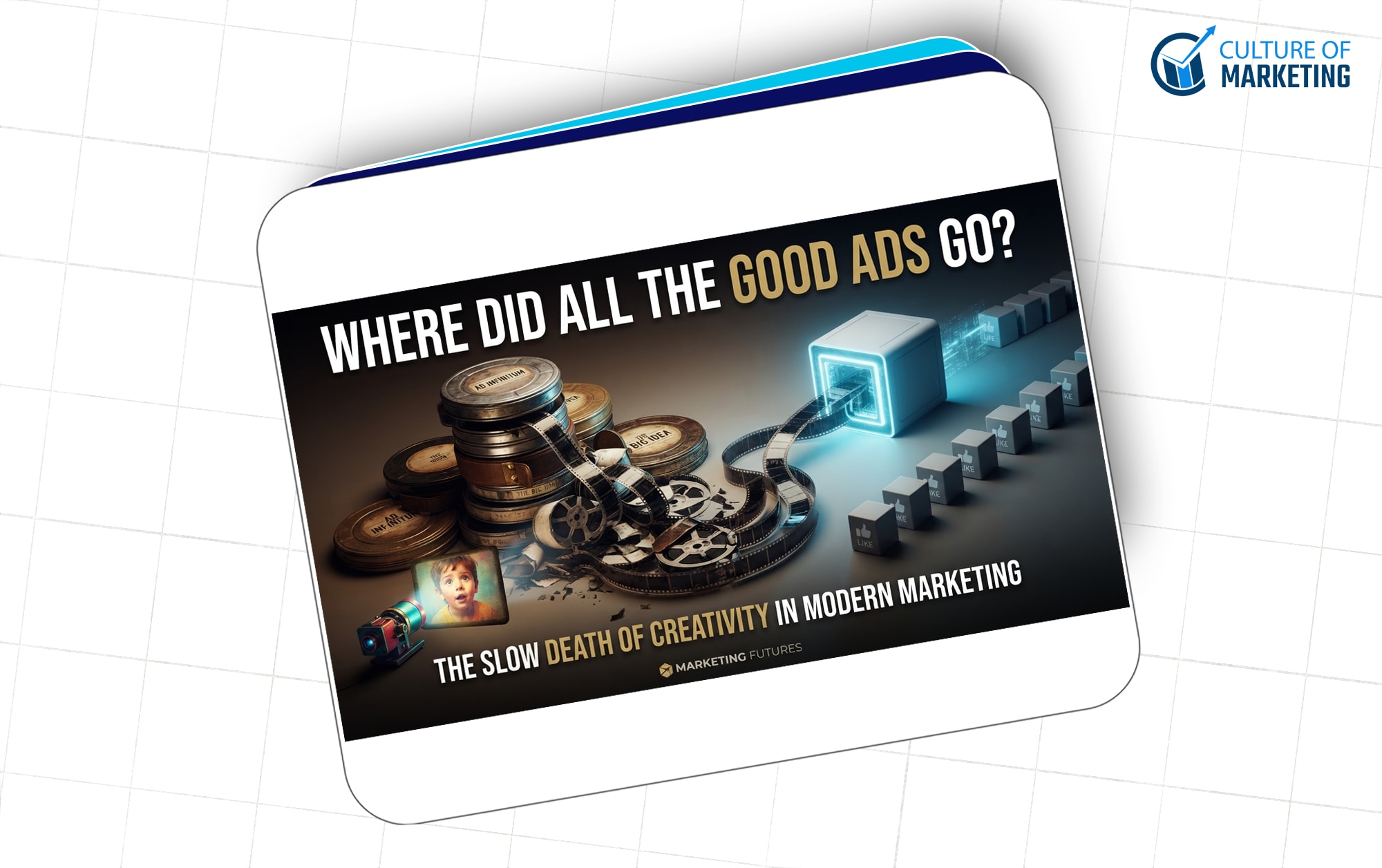
The Slow Death of Creativity in Modern Marketing
There's a particular kind of sadness that hits when you're scrolling through your feed, and you realise — genuinely realise — that you cannot remember a single ad you've seen in the last week. Not one. They all blurred together into a paste of stock footage, sans-serif fonts, and some variation of "transform your workflow." That didn't used to be the case. There was a time when people discussed ads the way they discussed movies, when a Super Bowl commercial could genuinely surprise you, when a campaign could make you feel something real, not just nudge you toward a purchase with a countdown timer and a discount code. That time feels very far away right now. And the question worth asking is: what actually happened?
The Data Trap That Killed the Big Idea
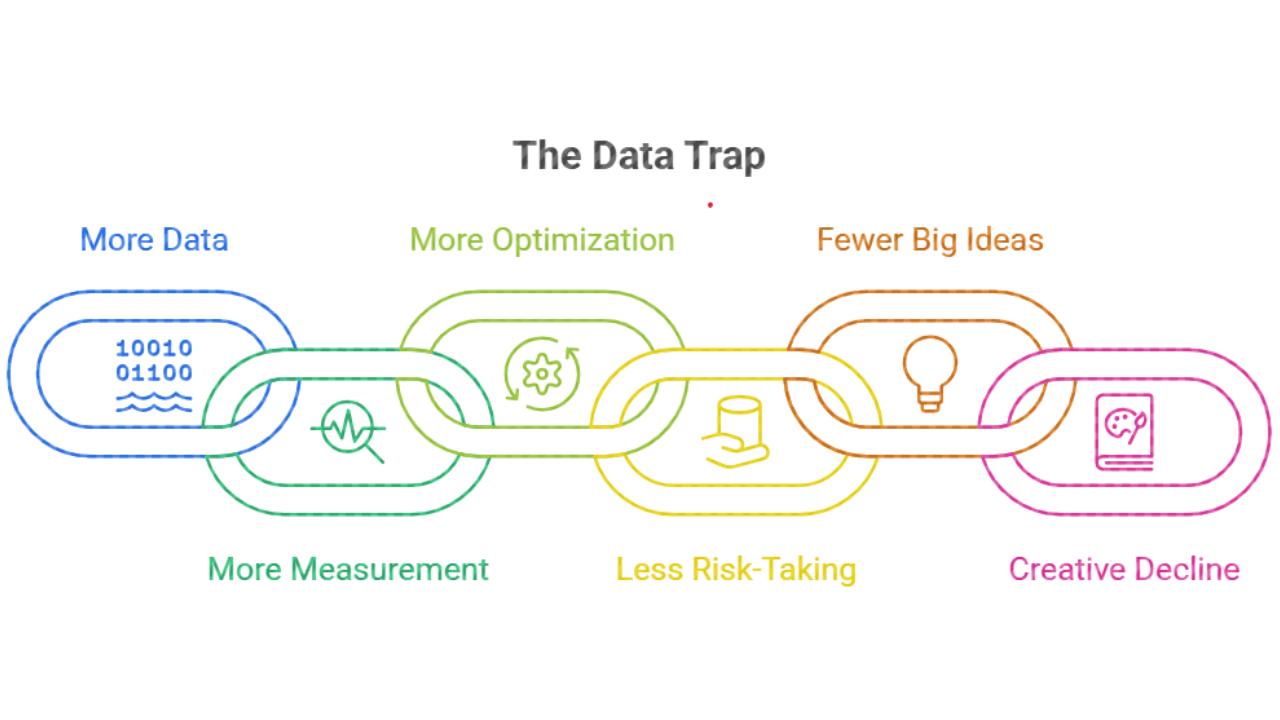
The most honest answer is that marketing got really, really good at measuring things — and then slowly started to only do the things it could measure.
Digital advertising gave marketers something they'd never had before: proof. Real-time proof. You could see exactly how many people clicked, how long they stayed, what they bought, and when they left. For anyone who'd ever had to justify a budget based on gut feeling and focus groups, that kind of certainty felt like a gift.
But here's where it quietly went wrong. When you can measure everything, the pressure shifts toward optimising everything. And optimisation, by its very nature, favours what's already working over what might work better. It's a machine that gets very good at refining the present — and almost completely blind to the future.
Creativity doesn't optimise well. A genuinely original idea has no performance data behind it. You can't A/B test boldness. You can't run a regression on whether something is going to make people feel seen, surprised, or moved. So over time, in meetings and budget reviews and quarterly planning sessions, the creative ideas that couldn't be justified with a chart quietly stopped getting approved.
Performance Marketing Became the Only Marketing
Somewhere along the way, "performance marketing" stopped being one type of marketing and started being the definition of marketing.
And look — performance marketing works. Paid search, retargeting, conversion optimization, email sequences — these things genuinely drive revenue. No one is disputing that. But when an entire brand's marketing strategy collapses down to what can be directly attributed to a sale in a 30-day window, you've stopped building a brand and started running a very expensive vending machine.
The problem is that the things that make people genuinely love a brand — the stories, the imagery, the cultural moments, the feeling that a company actually stands for something — rarely show up cleanly in a last-click attribution model. So they get cut. Year after year, the brand budget shrinks, and the performance budget grows. The ads get more targeted and less interesting. The messaging gets more precise and less human. And then five years later, someone in a boardroom asks why customer acquisition costs are climbing and why brand loyalty has basically evaporated. Nobody connects it to the creative gutting that happened half a decade earlier, because the connection is too diffuse, too hard to prove in a spreadsheet.
AI Made It Worse — and Also Showed Us the Problem
The arrival of AI-generated content accelerated something that was already well underway, but it made the symptoms impossible to ignore.
Suddenly, brands could produce content at an almost infinite scale. Blog posts, social captions, ad copy, email sequences — all of it generated in seconds, endlessly, cheaply. And a lot of it is fine. Technically competent. Grammatically correct. Completely forgettable.
The problem isn't that AI writes badly. The problem is that AI writes on average — it's trained on what already exists, so by definition, it produces content that looks like everything else. When every brand starts using the same tools with the same prompts and the same optimisation targets, the output converges. Everything starts to sound like a press release written by a committee.
Here's what that actually costs brands:
Distinctiveness. The one thing a brand genuinely cannot afford to lose is the ability to be recognised without a logo. When your content sounds like everyone else's content, you've essentially handed your audience over to whoever is willing to be more interesting.
Emotional resonance. Great creative work makes people feel something — seen, amused, inspired, understood. Algorithmically optimised content is engineered to get a click, which is a fundamentally different goal. Clicks don't build loyalty.
Cultural relevance. The brands that manage to become genuinely embedded in culture — the ones people reference in conversation, defend when criticised, feel proud to be associated with — got there through creative risk-taking, not through a/b testing their way to a 2.3% lift in CTR.
The Homogenization Nobody's Talking About
There's a specific aesthetic that took over marketing somewhere around 2018 and never really left. You know exactly what it looks like:
Clean white background. Millennial pink or sage green. A sans-serif font with generous tracking. "We're reimagining the way you think about [insert mundane product category]." A founder's story about a personal pain point. A pledge to give back 1% of every purchase.
Every brand, regardless of what they actually sell, started to look and sound like every other brand. The visual language that was once fresh and distinctive became so universally adopted that it stopped communicating anything at all — except perhaps "we hired someone who's been on Instagram."
This homogenization isn't just an aesthetic problem. It's a business problem. When customers can't tell brands apart, they make decisions based on price and convenience — two things where most brands are not competing at an advantage. That is where (the psychology prestige) becomes important — people don't always choose a brand because it is objectively better; they often choose it because of what the brand signals about taste, identity, status, and belonging. Differentiation lives in creative work. When creative work disappears, so does the reason to choose you over anyone else.
What the Brands Getting It Right Are Actually Doing
The good news — and there is good news — is that creative drought creates opportunity. When everything looks the same, being different is easier than it's ever been. A handful of brands have figured this out, and they're pulling away from the pack in ways that can't be replicated by a competitor with a better bidding strategy.
They're making things people actually want to watch. Not pre-roll ads that count down to a skip button. Actual content with genuine entertainment value — campaigns people share without being incentivized to.
They have a clear, consistent point of view. Not a mission statement written by a consultant. A real perspective on the world that shows up in every piece of content they put out, whether it's an Instagram story or a billboard.
They take creative risks with budgets that don't feel like risks. They don't wait until the brief calls for something bold — they build boldness into the brief from the start.
They hire for taste, not just technical skill. The people making decisions about creative work have genuine creative instincts, not just platform certifications.
They resist the pressure to explain the joke. Great creative work trusts the audience. It doesn't spell out the message in a caption underneath the visual. It gives people credit for being smart enough to feel the point.
Creativity Isn't a Luxury. It's the Whole Game.
There's a version of this conversation that frames creativity as the "nice to have" — the thing you invest in once all the performance channels are fully optimised. That framing is backwards, and following it has quietly tanked more than a few brands that thought they were being financially responsible.
Creativity is what makes someone care that your brand exists. Performance marketing is what captures the demand that creativity generates. They are not the same function, and one cannot replace the other. When brands treat them as interchangeable — when they cut the brand budget and call it efficiency — they're spending down a reserve they don't know they have until it's gone.
The brands worth talking about, worth following, worth defending — they didn't get there by finding the optimal bidding strategy. They got there because someone, at some point, made something genuinely worth paying attention to. And then they kept doing it.
The question for any marketer worth their paycheck right now isn't whether creativity matters. It's whether they're willing to fight for it inside organisations that have gotten very comfortable optimising for the safe, the measurable, and the forgettable. That fight is worth having. Because the alternative — more beige content, more A/B-tested mediocrity, more ads nobody remembers — isn't a marketing strategy. It's just noise.